Recent changes are no longer compatible with the old version of boulder used in the test farm tests. This PR updates the version of boulder used, and runs it with the new way of running boulder.

A new ami was created and is used here that uses Ubuntu 18.04, so that docker-compose can be installed more properly.

Removed commented-out section about rabbitmq that was already deprecated.

Switched to using the public DNS resolver 8.8.8.8 for the tests because the way to find the correct local resolver changed.
This PR attempts to better inform people about the problem identified at https://community.letsencrypt.org/t/certbot-auto-deployment-best-practices/91979/.

I was hesitant to add the flag --no-permissions-check, however, if there's some obscure distro out there (or custom user setup) that has a strange users and groups, I didn't want us to either:

Have to put out a bug fix release
Refuse to fix the problem and let them deal with warnings on every run

* add check_permissions.py

* Update letsencrypt-auto.template.

* build letsencrypt-auto

* Add test_permissions_warnings to auto_test

* Allow uid/gid < 1000.

* Add --no-permissions-check to Certbot.

* Add --no-permissions-check to certbot-auto.

* Add test farm test that letsencrypt-auto is quiet.

As a bonus, this new test will catch problems like the one that the caused
0.33.1 point release.

* Update CHANGELOG about permissions check.

* Update permissions comment.

* Fix symlink handling.

* Use a better default in auto_test.py.
First step of #6960.

* Warn install users that future versions of certbot will automatically redirect

* Only warn when the user declines or auto-declines redirect

* Unit tests

* Update changelog
* certbot-dns-linode : Added support for linode version 4 tokens

* certbot-dns-linode : Added credentials ini option to override automatic api version detection

* certbot-dns-linode : Added clearer messages and documentation based on review

* certbot-dns-linode : Added check for empty 'linode_version' config instead of missing

* certbot-dns-linode : Fix rebase on master

* certbot-dns-linode : Updated local-oldest-requirements.txt

* Updated CHANGELOG to indicate Linode v4 API key support
Fixes#6974.
This PR removes the fallback that consists in retrying to send the keyAuthorization field during a challenge request in case of malformed request.
* Remove keyAuthorization fallback dump in challenges response
* Correct import
* Add changelog entry
This PR is the part 4 to implement #6541. It adds the integration tests for the nginx certbot plugin, and corresponds to the certbot-ci translation of certbot-nginx/tests/boulder-integration.sh that is executed for each PR.

As with certbot core tests, tests are written in Python, and executed by pytest, against a dynamic Boulder/Pebble instance setup. Tests are parallelized, of course, and a specific IntegrationTestsContext class, extended the one from certbot core tests, is crafter for these specific tests: its main goal is to setup a specific nginx instance for the current test.

On top of that, I use the test parametrization feature of Pytest, to drastically reduce the size of the actual code: indeed, the 6 tests from the original bash script share the same logic. So using a parametrization, one unique test is written, that is then executed 6 times against 6 different sets of parameters.

Note that the module integration_tests.nginx_tests.nginx_config do the same, but in Python, than certbot-nginx/tests/boulder-integration.conf.sh. The latter will be removed in a future PR, with all other bash scripts.

* Add nginx tests

* Distribute the other_port

* Load a pre-generated key/cert for nginx config

* Correct preload, remove a test, simplify a variable

* Integrate assertion directly in the test function

* Check process is not terminated

* Add spaces in the nginx config

* Add comments

* Use indirection

* Allow external cert

* Add coverage threshold for certbot-nginx
I came across this when looking through our docs for other references to certbot-auto.

For the README changes, I deleted a bunch of duplicated and outdated instructions in favor of pointing people to https://certbot.eff.org.
Following #6821, this PR continues to convert certbot integration tests into certbot-ci.

This PR add tests covering checks on L430-447 in tests/certbot-boulder-integration.sh. Previous lines are covered with existing tests, or by #6946, #6947, #6948, #6949.

* Add tests

* Change param

* Increase coverage min to 64%

* Disable OCSP Must-Staple test for Pebble
Following #6821, this PR continues to convert certbot integration tests into certbot-ci.

This PR add tests covering checks on L531 to the end on tests/certbot-boulder-integration.sh. Previous lines are covered with existing tests, or by #6946, #6947, #6948, #6949, #6951, #6952.

* Add tests

* Add load resource

* Separate OCSP in two tests

* Copy new asset

* Load the asset

* Add coverage limit
Following #6821, this PR continues to convert certbot integration tests into certbot-ci.

This PR add tests covering checks on L448-530 in tests/certbot-boulder-integration.sh. Previous lines are covered with existing tests, or by #6946, #6947, #6948, #6949, #6951.

* Add tests

* Normalize paths

* Fix merge error in git
Following #6821, this PR continues to convert certbot integration tests into certbot-ci.

This PR add tests covering checks on L397-429 in tests/certbot-boulder-integration.sh. Previous lines are covered with existing tests, or by #6946, #6947 and #6948.

* Add tests

* Change a variable name

* Fix merge errors from git
Following #6821, this PR continues to convert certbot integration tests into certbot-ci.

This PR add tests covering about renew, on L283-396 in tests/certbot-boulder-integration.sh (by including existing test_renew_files_permissions and test_renew_with_hook_scripts). Previous lines are covered with existing tests, or by #6946 and #6947.

* Add tests

* Correct assertion about world permission
Following #6821, this PR continues to convert certbot integration tests into certbot-ci.

This PR add tests covering on L268-282 in tests/certbot-boulder-integration.sh. Previous lines are covered with existing tests, or by #6946.

* Add tests

* Fix CSR generation

* Add dependency
Following #6821, this PR continues to convert certbot integration tests into certbot-ci.

This PR add tests covering on L185-222 in tests/certbot-boulder-integration.sh.

* Add tests

* Correct some assertions
This PR is the second part of #6497 to ease the integration, following the new plan propose by @bmw here: #6497 (comment)

This PR creates the module certbot.compat.os, that delegates everything to os, and that will be the safeguard against problematic methods of the standard module. On top of that, a quality check wrapper is called in the lint tox environment. This wrapper calls pylint and ensures that standard os module is no used directly in the certbot codebase.

Finally local oldest requirements are updated to ensure that tests will take the new logic when running.

* Add executable permissions

* Add the delegate certbot.compat.os module, add check coding style to enforce usage of certbot.compat.os instead of standard os

* Load certbot.compat.os instead of os

* Move existing compat test

* Update local oldest requirements

* Import sys

* Update account_test.py

* Update os.py

* Update os.py

* Update local oldest requirements

* Implement the new linter_plugin

* Fix local oldest for nginx

* Remove check coding style

* Update linter_plugin.py

* Add several comments

* Update the setup.py

* Add documentation

* Update acme dependencies

* Update certbot/compat/os.py

* Update docs/contributing.rst

* Update linter_plugin.py

* Handle os.path. Simplify checker.

* Add a comment to a reference implementation

* Update changelog

* Fix module registering

* Update docs/contributing.rst

* Update config and changelog
This PR adds a step to Apache plugin config_test when run on Fedora. Because Fedora now creates self signed certificate and related key material upon first startup of httpd. This was causing issues for users who run certbot-auto or install certbot (and mod_ssl) and run Certbot directly after.

Fixes: #6828

* Try to restart httpd on Fedora if config check fails

* Update CHANGELOG.md
Following #6934, this PR finalize two things, as explained in #6934:

disable the default aggregated report
validate linux and windows reports against the PR base branch
So, we observed lately several inconsistencies in how Codecov behave toward the CI pipeline for PRs in Certbot. One example is #6888. The most annoying thing is that the build of PR is **temporary** marked as failed, until all coverage are run.
The correction on the latter is done in two PRs. This is the first part.
TL;DR
This PR separates the Codecov report in two: one for coverage executed on Windows, one for Linux. This is the correct way to do regarding our current CI pipeline. Actions are required by a GitHub administrator of Certbot once this PR is merged.
Complete explanation
So the failure stated in the introduction is essentially due to several things interacting together:
* AppVeyor generates a coverage report for Windows, that have a coverage value a little lower than on Linux (96%)
* Travis generates a coverage report for Linux. Its coverage is higher, and slowly decrease as more specific Windows code is added to Certbot, that cannot be tested on Travis
* Since AppVeyor saw its capacity increasing, it finishes its coverage job before the one from Travis
* Certbot GitHub repo is configured to require the coverage pipeline to succeed (in whatever that means) to success the overall PR build
So here the suite of events:
1) PR is issued. GitHub expect three pipeline to succeed: AppVeyor CI, Travis CI and Codecov (displayed in the PR page)
2) Codecov receive first the report of AppVeyor coverage. It is 96%. It is a failure for now, because coverage in master (AppVeyor+Travis) is 98.6%.
3) GitHub is reported of the failure on Codecov, so fail the PR build
4) Codecov receive then the report of Travis coverage. It is 98%. It merges it with the report from AppVeyor, leading to the 98.6%. The failure becomes a success.
5) GitHub is reported of the success on Codecov, so, nevermind, the PR build is a success finally!
So we have a CI flow that change its mind. Great. This is because of 2) and 4), and we could expect that Codecov should handle that. This is not the case: it is somewhat misleading, because Codecov adverts a lot about its capability to merge reports, including from different CI. But it is about the final state, not about the transient state, while reports are progressively received.
Two things to things that a transient state is existing, with a result that can change:
* first, from Codecov doc itself, explaining that reports should not be trusted during the CI pipeline execution: https://docs.codecov.io/docs/ci-service-relationship#section-checking-ci-status
* second, is an example of transient state of `cryptography` project, this is advert by Codecov to be a reference of the implementation:
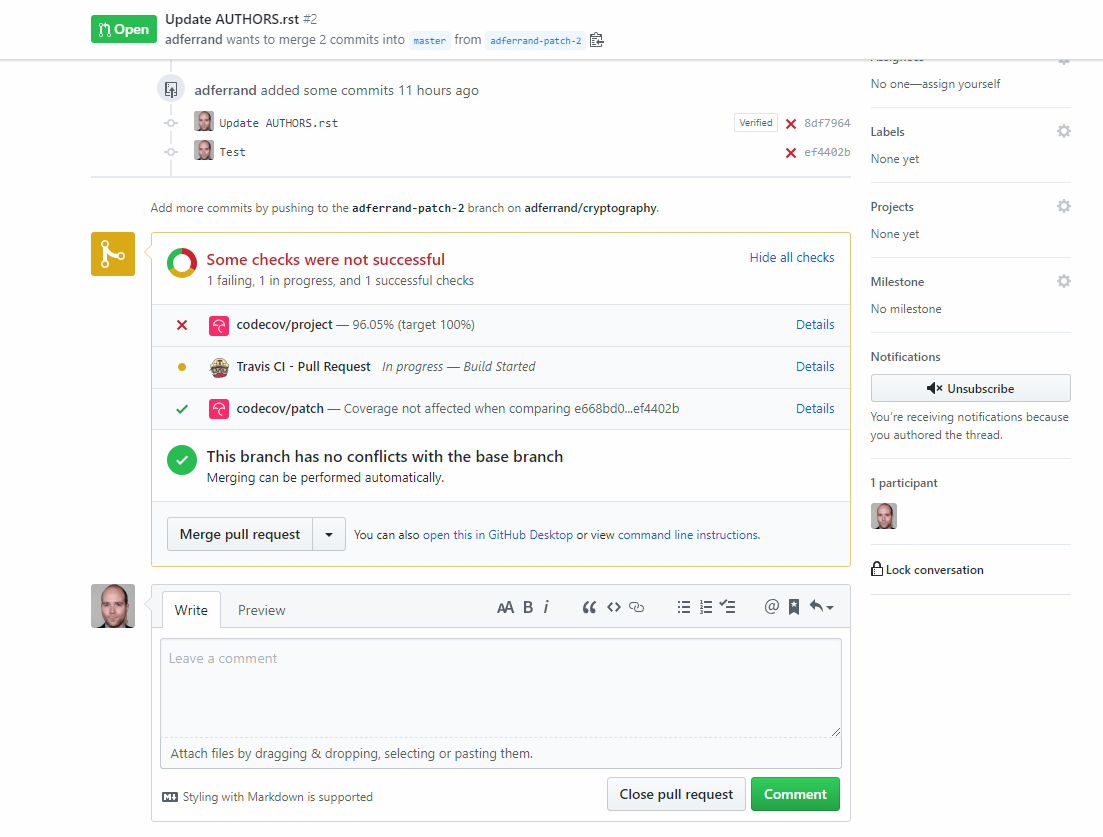
As you can see above, build state of `cryptography` is failing after the first report is received, and until all coverage reports from Travis are received.
So, what can we do about it? Thing is, we are aggregating coverage from very two unrelated sources (two different OS systems), and Codecov has something for that. This is flags: https://docs.codecov.io/docs/flags
Flags allow to flag coverage material depending on any logic you apply to the command that uploaded the coverage report (eg. `codecov -F a_flag`). Then, several logics can be applied on it, for instance having in Codecov UI the capability to filter the coverage other a flag, having status of build for each flag and ... having a report for a specific flag.
So:
1) I modified Travis and AppVeyor to send their report under a specific flag: `linux` or `windows`
2) I created a project specific `.codecov.yml` configuration in Certbot repository, to instruct Codecov to push two separate reports on GitHub build: one for Linux, one for Windows. Each report can be validated against its specific coverage from the `master` branch (more on this just after)
With all of this, now the GitHub is succeeding, because each coverage is validated independently.
I think it is the good approach, because it solves the specific issue here, and because it reflects the logic behind: merging coverage from different OS architectures does not make much sense. It would be a long-term problem, because as I said at the beginning, coverages will slowly decrease as more platform specific code is added in Certbot.
Now, it is not finished. Two things need to be done: an administrator action, and a second PR
Administrator action
Certbot GitHub as a a branch protection rule (Settings > Branches > Branch protection rules). It needs to be changed.
Indeed this rule is expecting the full coverage report (named `codecov/project`) to be valid on a PR. It needs to be changed to expect two coverage reports: `codecov/project/linux` and `codecov/project/windows`. The `codecov/project` needs to be removed.
This can be done once this PR is merged, and the specific coverage reports have been generated on master.
Second PR
Once this PR is merged and administrative actions have been done. I will make a new PR modifying `.codecov.yml` with two things:
* disable the faulty full coverage report, that is not required anymore by GitHub branch protection rules
* modify the `linux` and `windows` reports to validate against the relevant coverage calculated from `master` (indeed, in this PR it is a fixed ratio rule, since the coverage to compare on master is the full coverage one, significantly higher)
* Tag reports
* Set per-project codecov configuration
Fixes#6861.
_venv_common.py is no longer executable. The reason for this is the venv creation logic is now different between Python 2 and Python 3. We could add code that branches on the Python version running the script, but I personally think that's unnecessary.
--setuptools and --no-site-packages is no longer passed to virtualenv either. These flags were made noops in virtualenv 1.10 and 1.7 respectively, but all of CentOS 6, 7, Debian 8+, and Ubuntu 14.04+ have new enough versions of virtualenv where these flags are no longer necessary. They are not even accepted as flags to Python 3's venv module.
Use of VENV_ARGS from test_sdists.sh was also removed because that environment variable hasn't done anything in a while.
I ran test farm tests on test_apache2.sh and test_sdists.sh with these changes and they passed.
* Fixes#6861.
* _venv_common is no longer executable.


