mirror of
https://github.com/huggingface/diffusers.git
synced 2026-01-29 07:22:12 +03:00

123 lines
10 KiB
Markdown
123 lines
10 KiB
Markdown
<!--
|
|
Copyright 2023-2025 Marigold Team, ETH Zürich. All rights reserved.
|
|
Copyright 2024-2025 The HuggingFace Team. All rights reserved.
|
|
|
|
Licensed under the Apache License, Version 2.0 (the "License"); you may not use this file except in compliance with
|
|
the License. You may obtain a copy of the License at
|
|
|
|
http://www.apache.org/licenses/LICENSE-2.0
|
|
|
|
Unless required by applicable law or agreed to in writing, software distributed under the License is distributed on
|
|
an "AS IS" BASIS, WITHOUT WARRANTIES OR CONDITIONS OF ANY KIND, either express or implied. See the License for the
|
|
specific language governing permissions and limitations under the License.
|
|
-->
|
|
|
|
# Marigold Computer Vision
|
|
|
|
|
|
|
|
Marigold was proposed in
|
|
[Repurposing Diffusion-Based Image Generators for Monocular Depth Estimation](https://huggingface.co/papers/2312.02145),
|
|
a CVPR 2024 Oral paper by
|
|
[Bingxin Ke](http://www.kebingxin.com/),
|
|
[Anton Obukhov](https://www.obukhov.ai/),
|
|
[Shengyu Huang](https://shengyuh.github.io/),
|
|
[Nando Metzger](https://nandometzger.github.io/),
|
|
[Rodrigo Caye Daudt](https://rcdaudt.github.io/), and
|
|
[Konrad Schindler](https://scholar.google.com/citations?user=FZuNgqIAAAAJ&hl=en).
|
|
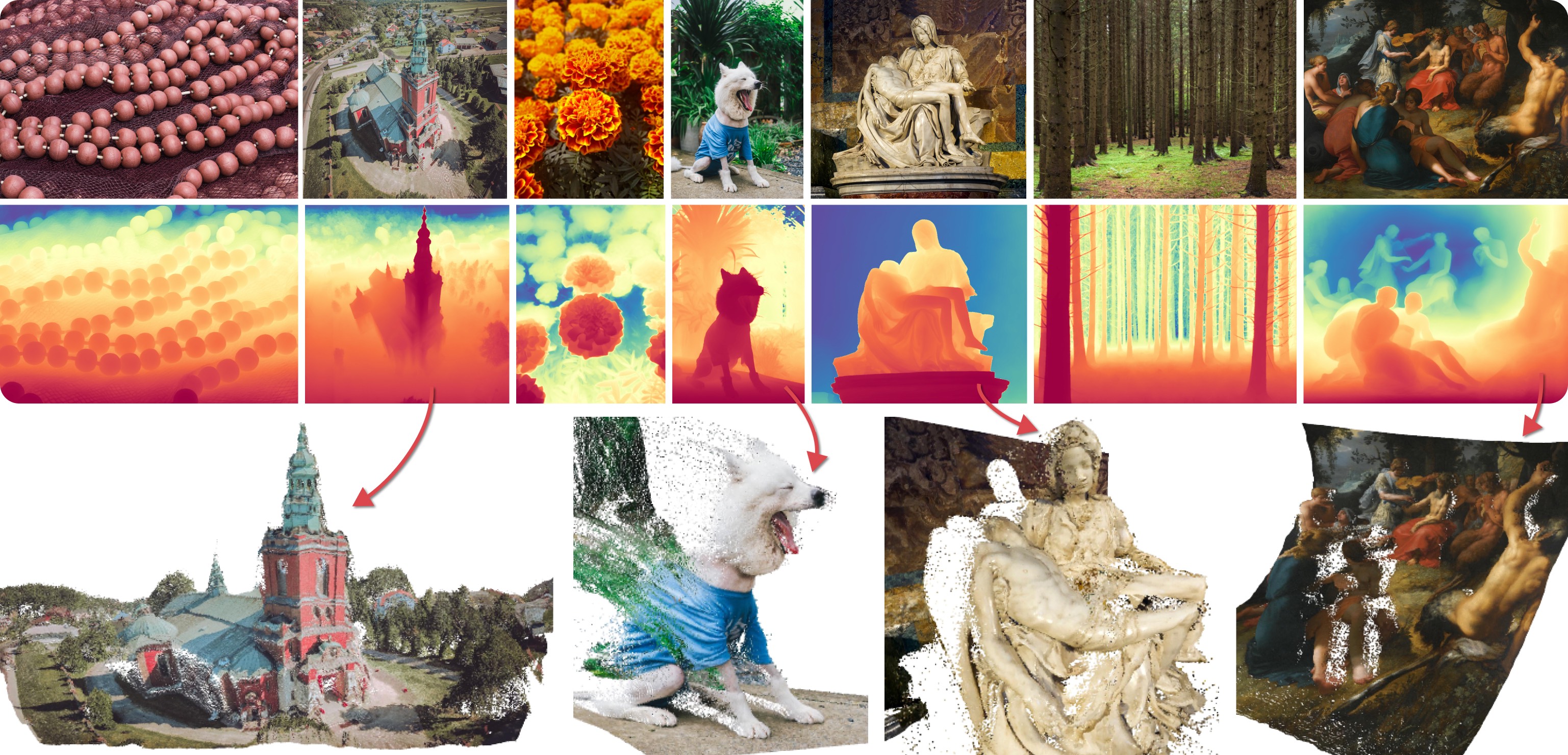
The core idea is to **repurpose the generative prior of Text-to-Image Latent Diffusion Models (LDMs) for traditional
|
|
computer vision tasks**.
|
|
This approach was explored by fine-tuning Stable Diffusion for **Monocular Depth Estimation**, as demonstrated in the
|
|
teaser above.
|
|
|
|
Marigold was later extended in the follow-up paper,
|
|
[Marigold: Affordable Adaptation of Diffusion-Based Image Generators for Image Analysis](https://huggingface.co/papers/2312.02145),
|
|
authored by
|
|
[Bingxin Ke](http://www.kebingxin.com/),
|
|
[Kevin Qu](https://www.linkedin.com/in/kevin-qu-b3417621b/?locale=en_US),
|
|
[Tianfu Wang](https://tianfwang.github.io/),
|
|
[Nando Metzger](https://nandometzger.github.io/),
|
|
[Shengyu Huang](https://shengyuh.github.io/),
|
|
[Bo Li](https://www.linkedin.com/in/bobboli0202/),
|
|
[Anton Obukhov](https://www.obukhov.ai/), and
|
|
[Konrad Schindler](https://scholar.google.com/citations?user=FZuNgqIAAAAJ&hl=en).
|
|
This work expanded Marigold to support new modalities such as **Surface Normals** and **Intrinsic Image Decomposition**
|
|
(IID), introduced a training protocol for **Latent Consistency Models** (LCM), and demonstrated **High-Resolution** (HR)
|
|
processing capability.
|
|
|
|
> [!TIP]
|
|
> The early Marigold models (`v1-0` and earlier) were optimized for best results with at least 10 inference steps.
|
|
> LCM models were later developed to enable high-quality inference in just 1 to 4 steps.
|
|
> Marigold models `v1-1` and later use the DDIM scheduler to achieve optimal
|
|
> results in as few as 1 to 4 steps.
|
|
|
|
## Available Pipelines
|
|
|
|
Each pipeline is tailored for a specific computer vision task, processing an input RGB image and generating a
|
|
corresponding prediction.
|
|
Currently, the following computer vision tasks are implemented:
|
|
|
|
| Pipeline | Recommended Model Checkpoints | Spaces (Interactive Apps) | Predicted Modalities |
|
|
|---------------------------------------------------------------------------------------------------------------------------------------------------|---------------------------------------------------------------------------------------------------------------------------------------------------------------------------------------------------------|:------------------------------------------------------------------------------------:|------------------------------------------------------------------------------------------------------------------------------------------------------------------------------------|
|
|
| [MarigoldDepthPipeline](https://github.com/huggingface/diffusers/blob/main/src/diffusers/pipelines/marigold/pipeline_marigold_depth.py) | [prs-eth/marigold-depth-v1-1](https://huggingface.co/prs-eth/marigold-depth-v1-1) | [Depth Estimation](https://huggingface.co/spaces/prs-eth/marigold) | [Depth](https://en.wikipedia.org/wiki/Depth_map), [Disparity](https://en.wikipedia.org/wiki/Binocular_disparity) |
|
|
| [MarigoldNormalsPipeline](https://github.com/huggingface/diffusers/blob/main/src/diffusers/pipelines/marigold/pipeline_marigold_normals.py) | [prs-eth/marigold-normals-v1-1](https://huggingface.co/prs-eth/marigold-normals-v1-1) | [Surface Normals Estimation](https://huggingface.co/spaces/prs-eth/marigold-normals) | [Surface normals](https://en.wikipedia.org/wiki/Normal_mapping) |
|
|
| [MarigoldIntrinsicsPipeline](https://github.com/huggingface/diffusers/blob/main/src/diffusers/pipelines/marigold/pipeline_marigold_intrinsics.py) | [prs-eth/marigold-iid-appearance-v1-1](https://huggingface.co/prs-eth/marigold-iid-appearance-v1-1),<br>[prs-eth/marigold-iid-lighting-v1-1](https://huggingface.co/prs-eth/marigold-iid-lighting-v1-1) | [Intrinsic Image Decomposition](https://huggingface.co/spaces/prs-eth/marigold-iid) | [Albedo](https://en.wikipedia.org/wiki/Albedo), [Materials](https://www.n.aiq3d.com/wiki/roughnessmetalnessao-map), [Lighting](https://en.wikipedia.org/wiki/Diffuse_reflection) |
|
|
|
|
## Available Checkpoints
|
|
|
|
All original checkpoints are available under the [PRS-ETH](https://huggingface.co/prs-eth/) organization on Hugging Face.
|
|
They are designed for use with diffusers pipelines and the [original codebase](https://github.com/prs-eth/marigold), which can also be used to train
|
|
new model checkpoints.
|
|
The following is a summary of the recommended checkpoints, all of which produce reliable results with 1 to 4 steps.
|
|
|
|
| Checkpoint | Modality | Comment |
|
|
|-----------------------------------------------------------------------------------------------------|--------------|--------------------------------------------------------------------------------------------------------------------------------------------------------------------------------------|
|
|
| [prs-eth/marigold-depth-v1-1](https://huggingface.co/prs-eth/marigold-depth-v1-1) | Depth | Affine-invariant depth prediction assigns each pixel a value between 0 (near plane) and 1 (far plane), with both planes determined by the model during inference. |
|
|
| [prs-eth/marigold-normals-v0-1](https://huggingface.co/prs-eth/marigold-normals-v0-1) | Normals | The surface normals predictions are unit-length 3D vectors in the screen space camera, with values in the range from -1 to 1. |
|
|
| [prs-eth/marigold-iid-appearance-v1-1](https://huggingface.co/prs-eth/marigold-iid-appearance-v1-1) | Intrinsics | InteriorVerse decomposition is comprised of Albedo and two BRDF material properties: Roughness and Metallicity. |
|
|
| [prs-eth/marigold-iid-lighting-v1-1](https://huggingface.co/prs-eth/marigold-iid-lighting-v1-1) | Intrinsics | HyperSim decomposition of an image  \\(I\\)  is comprised of Albedo  \\(A\\), Diffuse shading  \\(S\\), and Non-diffuse residual  \\(R\\):  \\(I = A*S+R\\). |
|
|
|
|
> [!TIP]
|
|
> Make sure to check out the Schedulers [guide](../../using-diffusers/schedulers) to learn how to explore the tradeoff
|
|
> between scheduler speed and quality, and see the [reuse components across pipelines](../../using-diffusers/loading#reuse-a-pipeline) section to learn how to
|
|
> efficiently load the same components into multiple pipelines.
|
|
> Also, to know more about reducing the memory usage of this pipeline, refer to the ["Reduce memory usage"] section
|
|
> [here](../../using-diffusers/svd#reduce-memory-usage).
|
|
|
|
> [!WARNING]
|
|
> Marigold pipelines were designed and tested with the scheduler embedded in the model checkpoint.
|
|
> The optimal number of inference steps varies by scheduler, with no universal value that works best across all cases.
|
|
> To accommodate this, the `num_inference_steps` parameter in the pipeline's `__call__` method defaults to `None` (see the
|
|
> API reference).
|
|
> Unless set explicitly, it inherits the value from the `default_denoising_steps` field in the checkpoint configuration
|
|
> file (`model_index.json`).
|
|
> This ensures high-quality predictions when invoking the pipeline with only the `image` argument.
|
|
|
|
See also Marigold [usage examples](../../using-diffusers/marigold_usage).
|
|
|
|
## Marigold Depth Prediction API
|
|
|
|
[[autodoc]] MarigoldDepthPipeline
|
|
- __call__
|
|
|
|
[[autodoc]] pipelines.marigold.pipeline_marigold_depth.MarigoldDepthOutput
|
|
|
|
[[autodoc]] pipelines.marigold.marigold_image_processing.MarigoldImageProcessor.visualize_depth
|
|
|
|
## Marigold Normals Estimation API
|
|
[[autodoc]] MarigoldNormalsPipeline
|
|
- __call__
|
|
|
|
[[autodoc]] pipelines.marigold.pipeline_marigold_normals.MarigoldNormalsOutput
|
|
|
|
[[autodoc]] pipelines.marigold.marigold_image_processing.MarigoldImageProcessor.visualize_normals
|
|
|
|
## Marigold Intrinsic Image Decomposition API
|
|
|
|
[[autodoc]] MarigoldIntrinsicsPipeline
|
|
- __call__
|
|
|
|
[[autodoc]] pipelines.marigold.pipeline_marigold_intrinsics.MarigoldIntrinsicsOutput
|
|
|
|
[[autodoc]] pipelines.marigold.marigold_image_processing.MarigoldImageProcessor.visualize_intrinsics
|