mirror of
https://github.com/huggingface/diffusers.git
synced 2026-10-24 20:59:27 +03:00
 977162c02b
* add document on token merging.

* fix headline.

* fix: headline.

* add some samples for comparison.
116 lines
6.2 KiB
Plaintext
116 lines
6.2 KiB
Plaintext
<!--Copyright 2023 The HuggingFace Team. All rights reserved.
|
||
|
||
Licensed under the Apache License, Version 2.0 (the "License"); you may not use this file except in compliance with
|
||
the License. You may obtain a copy of the License at
|
||
|
||
http://www.apache.org/licenses/LICENSE-2.0
|
||
|
||
Unless required by applicable law or agreed to in writing, software distributed under the License is distributed on
|
||
an "AS IS" BASIS, WITHOUT WARRANTIES OR CONDITIONS OF ANY KIND, either express or implied. See the License for the
|
||
specific language governing permissions and limitations under the License.
|
||
-->
|
||
|
||
# Token Merging
|
||
|
||
Token Merging (introduced in [Token Merging: Your ViT But Faster](https://arxiv.org/abs/2210.09461)) works by merging the redundant tokens / patches progressively in the forward pass of a Transformer-based network. It can speed up the inference latency of the underlying network.
|
||
|
||
After Token Merging (ToMe) was released, the authors released [Token Merging for Fast Stable Diffusion](https://arxiv.org/abs/2303.17604), which introduced a version of ToMe which is more compatible with Stable Diffusion. We can use ToMe to gracefully speed up the inference latency of a [`DiffusionPipeline`]. This doc discusses how to apply ToMe to the [`StableDiffusionPipeline`], the expected speedups, and the qualitative aspects of using ToMe on the [`StableDiffusionPipeline`].
|
||
|
||
## Using ToMe
|
||
|
||
The authors of ToMe released a convenient Python library called [`tomesd`](https://github.com/dbolya/tomesd) that lets us apply ToMe to a [`DiffusionPipeline`] like so:
|
||
|
||
```diff
|
||
from diffusers import StableDiffusionPipeline
|
||
import tomesd
|
||
|
||
pipeline = StableDiffusionPipeline.from_pretrained(
|
||
"runwayml/stable-diffusion-v1-5", torch_dtype=torch.float16
|
||
).to("cuda")
|
||
+ tomesd.apply_patch(pipeline, ratio=0.5)
|
||
|
||
image = pipeline("a photo of an astronaut riding a horse on mars").images[0]
|
||
```
|
||
|
||
And that’s it!
|
||
|
||
`tomesd.apply_patch()` exposes [a number of arguments](https://github.com/dbolya/tomesd#usage) to let us strike a balance between the pipeline inference speed and the quality of the generated tokens. Amongst those arguments, the most important one is `ratio`. `ratio` controls the number of tokens that will be merged during the forward pass. For more details on `tomesd`, please refer to the original repository https://github.com/dbolya/tomesd and [the paper](https://arxiv.org/abs/2303.17604).
|
||
|
||
## Benchmarking `tomesd` with `StableDiffusionPipeline`
|
||
|
||
We benchmarked the impact of using `tomesd` on [`StableDiffusionPipeline`] along with [xformers](https://huggingface.co/docs/diffusers/optimization/xformers) across different image resolutions. We used A100 and V100 as our test GPU devices with the following development environment (with Python 3.8.5):
|
||
|
||
```bash
|
||
- `diffusers` version: 0.15.1
|
||
- Python version: 3.8.16
|
||
- PyTorch version (GPU?): 1.13.1+cu116 (True)
|
||
- Huggingface_hub version: 0.13.2
|
||
- Transformers version: 4.27.2
|
||
- Accelerate version: 0.18.0
|
||
- xFormers version: 0.0.16
|
||
- tomesd version: 0.1.2
|
||
```
|
||
|
||
We used this script for benchmarking: [https://gist.github.com/sayakpaul/27aec6bca7eb7b0e0aa4112205850335](https://gist.github.com/sayakpaul/27aec6bca7eb7b0e0aa4112205850335). Following are our findings:
|
||
|
||
### A100
|
||
|
||
| Resolution | Batch size | Vanilla | ToMe | ToMe + xFormers | ToMe speedup (%) | ToMe + xFormers speedup (%) |
|
||
| --- | --- | --- | --- | --- | --- | --- |
|
||
| 512 | 10 | 6.88 | 5.26 | 4.69 | 23.54651163 | 31.83139535 |
|
||
| | | | | | | |
|
||
| 768 | 10 | OOM | 14.71 | 11 | | |
|
||
| | 8 | OOM | 11.56 | 8.84 | | |
|
||
| | 4 | OOM | 5.98 | 4.66 | | |
|
||
| | 2 | 4.99 | 3.24 | 3.1 | 35.07014028 | 37.8757515 |
|
||
| | 1 | 3.29 | 2.24 | 2.03 | 31.91489362 | 38.29787234 |
|
||
| | | | | | | |
|
||
| 1024 | 10 | OOM | OOM | OOM | | |
|
||
| | 8 | OOM | OOM | OOM | | |
|
||
| | 4 | OOM | 12.51 | 9.09 | | |
|
||
| | 2 | OOM | 6.52 | 4.96 | | |
|
||
| | 1 | 6.4 | 3.61 | 2.81 | 43.59375 | 56.09375 |
|
||
|
||
***The timings reported here are in seconds. Speedups are calculated over the `Vanilla` timings.***
|
||
|
||
### V100
|
||
|
||
| Resolution | Batch size | Vanilla | ToMe | ToMe + xFormers | ToMe speedup (%) | ToMe + xFormers speedup (%) |
|
||
| --- | --- | --- | --- | --- | --- | --- |
|
||
| 512 | 10 | OOM | 10.03 | 9.29 | | |
|
||
| | 8 | OOM | 8.05 | 7.47 | | |
|
||
| | 4 | 5.7 | 4.3 | 3.98 | 24.56140351 | 30.1754386 |
|
||
| | 2 | 3.14 | 2.43 | 2.27 | 22.61146497 | 27.70700637 |
|
||
| | 1 | 1.88 | 1.57 | 1.57 | 16.4893617 | 16.4893617 |
|
||
| | | | | | | |
|
||
| 768 | 10 | OOM | OOM | 23.67 | | |
|
||
| | 8 | OOM | OOM | 18.81 | | |
|
||
| | 4 | OOM | 11.81 | 9.7 | | |
|
||
| | 2 | OOM | 6.27 | 5.2 | | |
|
||
| | 1 | 5.43 | 3.38 | 2.82 | 37.75322284 | 48.06629834 |
|
||
| | | | | | | |
|
||
| 1024 | 10 | OOM | OOM | OOM | | |
|
||
| | 8 | OOM | OOM | OOM | | |
|
||
| | 4 | OOM | OOM | 19.35 | | |
|
||
| | 2 | OOM | 13 | 10.78 | | |
|
||
| | 1 | OOM | 6.66 | 5.54 | | |
|
||
|
||
As seen in the tables above, the speedup with `tomesd` becomes more pronounced for larger image resolutions. It is also interesting to note that with `tomesd`, it becomes possible to run the pipeline on a higher resolution, like 1024x1024.
|
||
|
||
It might be possible to speed up inference even further with [`torch.compile()`](https://huggingface.co/docs/diffusers/optimization/torch2.0).
|
||
|
||
## Quality
|
||
|
||
As reported in [the paper](https://arxiv.org/abs/2303.17604), ToMe can preserve the quality of the generated images to a great extent while speeding up inference. By increasing the `ratio`, it is possible to further speed up inference, but that might come at the cost of a deterioration in the image quality.
|
||
|
||
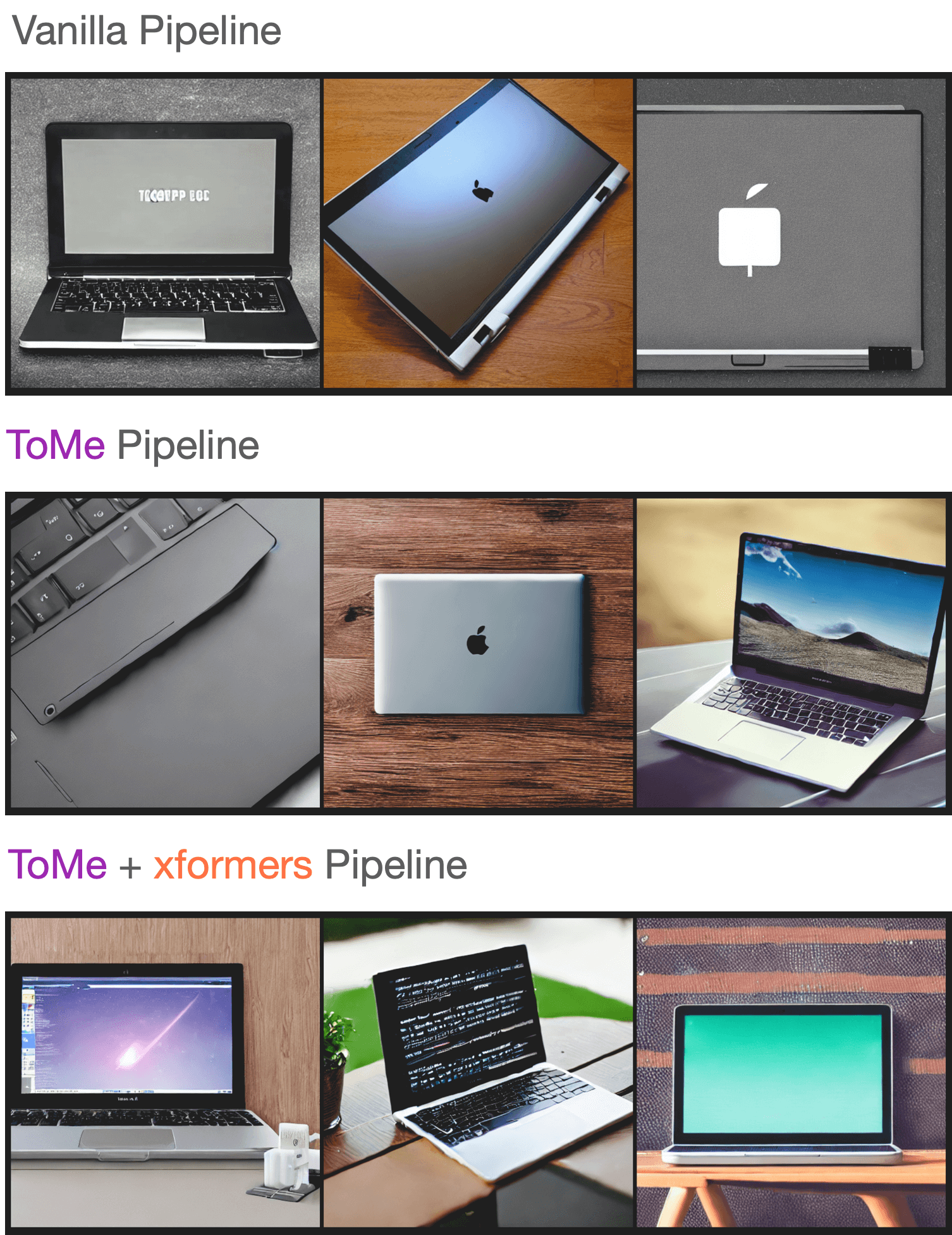
To test the quality of the generated samples using our setup, we sampled a few prompts from the “Parti Prompts” (introduced in [Parti](https://parti.research.google/)) and performed inference with the [`StableDiffusionPipeline`] in the following settings:
|
||
|
||
- Vanilla [`StableDiffusionPipeline`]
|
||
- [`StableDiffusionPipeline`] + ToMe
|
||
- [`StableDiffusionPipeline`] + ToMe + xformers
|
||
|
||
We didn’t notice any significant decrease in the quality of the generated samples. Here are samples:
|
||
|
||
|
||
|
||
You can check out the generated samples [here](https://wandb.ai/sayakpaul/tomesd-results/runs/23j4bj3i?workspace=). We used [this script](https://gist.github.com/sayakpaul/8cac98d7f22399085a060992f411ecbd) for conducting this experiment. |